CPQ is only half the battle
When it comes to managing product variants, many companies reach for a Configure, Price, Quote CPQ – Configure, Price, Quote (ˌsē-ˌpē-ˈkyü) n. abbr. CPQ stands for Configure, Price, Quote — software that automates sales quoting for configurable products by enforcing product rules, calculating pricing, and generating output. tool as their first — and sometimes only — solution. CPQ systems promise to tame the complexity of selling configurable products, helping sales teams avoid impossible combinations and generate quotes in record time. But here’s the catch: while CPQ is a powerful enabler for sales, it’s only one piece of a much larger puzzle.
What actually is CPQ — and what does it solve?
CPQ stands for Configure, Price, Quote. It’s a class of software that helps companies sell complex, configurable products. CPQ solutions can be used by internal sales staff or even directly by customers in a web shop. Without a system to guide the sales process, it’s easy to make mistakes: offering combinations that can’t be built, mispricing a custom order, or taking weeks to turn around a quote.
That’s where CPQ comes in. Modern CPQ tools act as digital sales assistants, guiding users through the configuration process, ensuring that only valid product combinations are selected, and instantly calculating prices based on the chosen options. Result: faster quotes, fewer errors, and a smoother customer experience. For many organizations, CPQ is a game changer in the sales phase — especially as products become more customizable and customers expect quick, accurate responses.
It’s important to recognize CPQ’s boundaries
But as powerful as CPQ is, it’s important to recognize its boundaries. CPQ systems are designed to support the sales process. They don’t architect the product, validate engineering changes, or ensure smooth production on the shop floor. Their main job is to translate complex product logic into user-friendly sales processes. For everything that happens before and after the sale — like requirements management, detailed engineering, or aftersales service — other processes and systems need to come into play.
In short: CPQ is an essential tool, but it’s not the whole toolbox.
From CPQ to end-to-end
In reality, variant management Variant Management (ˈver-ē-ənt ˈma-nij-mənt) n. Variant management: offering individual customers the best fitting solution with minimum internal complexity — a cross-sectional discipline, not a framework. stretches far beyond the sales department. The choices made upstream in product management and engineering directly impact what’s possible downstream in production, logistics, and aftersales. If your approach to variants stops at the sales portal, you risk creating friction, inefficiencies, and even costly errors elsewhere in your organization.
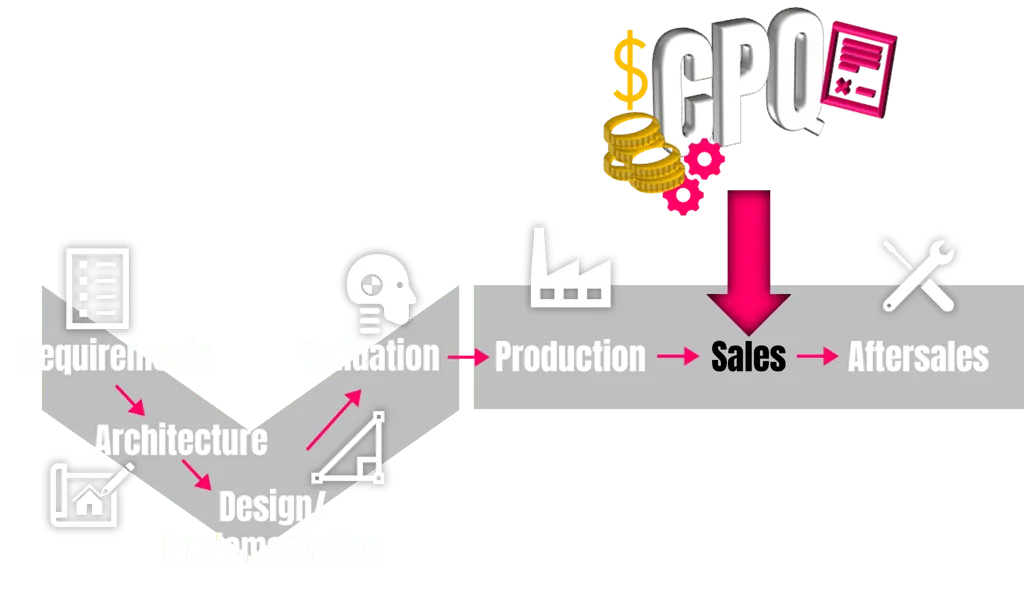
Companies who treat variant management as an end-to-end discipline — integrating processes and data across departments — are better equipped to deliver customized products efficiently and at scale.
The Full Scope: What End-to-End Variant Management Means
Variant management is about much more than sales configuration. It starts with understanding customer requirements, then moves to modular product architecture Product Architecture (ˈprä-dəkt ˈär-kə-ˌtek-chər) n. Product architecture defines how a product is decomposed into functional and physical elements and how those elements interact — a key decision in variant management strategy. , validation, and testing. Manufacturing and logistics must be prepared for diverse configurations, and aftersales teams need to support each variant with the right parts and documentation. End-to-end variant management connects all these steps, turning complexity into a competitive advantage.
The Risks of a CPQ-Only Approach
Focusing solely on CPQ can lead to disconnects between sales and the rest of the organization. Sales might configure products that can’t actually be built, or create variants that disrupt production and logistics. CPQ doesn’t automatically validate configurations against engineering or supply chain constraints. This can result in costly errors, delays, and unhappy customers. To truly deliver configurable products, organizations must connect processes from requirements to aftersales.
How to Build True End-to-End Variant Management
Achieving real end-to-end variant management starts with cross-functional collaboration. Sales, engineering, production, and service must work together, supported by integrated IT systems like PLM Product Lifecycle Management (PLM) (ˈprä-dəkt ˈlīf-ˌsī-kəl ˈma-nij-mənt) n. PLM (Product Lifecycle Management) manages product data, processes, and decisions across the full lifecycle — from design through manufacturing, service, and end of life. , ERP, and CPQ. Seamless data flow and regular feedback loops help teams adapt and improve. Training and change management ensure everyone understands both the tools and the reasons behind the process. With the right mindset and systems, companies can turn variant complexity into a real advantage.
Conclusion
Relying on CPQ alone isn’t enough for successful variant management. The real value comes from integrating processes and systems across departments and building a collaborative culture. Companies that get this right can offer tailored solutions at scale and respond quickly to market changes. Expert guidance is crucial for navigating these technical and organizational challenges.
With the right approach, variant complexity becomes a business strength.
Frequently asked questions
What is CPQ software and what problems does it solve?
CPQ stands for Configure, Price, Quote. It is a class of software that helps companies sell complex, configurable products by guiding users through the configuration process, validating that only technically permissible combinations are selected, and automatically calculating prices. CPQ can be used by internal sales staff or directly by customers in a web shop. It eliminates common sales errors — such as quoting impossible combinations or taking weeks to produce a manual price calculation — and is particularly valuable when products have many interdependent options. For organizations selling highly customizable products, CPQ is often a significant step forward in sales efficiency.
What is the difference between CPQ and end-to-end variant management?
The comparison is a bit of an apples-to-oranges one: CPQ is a category of software tools, while end-to-end variant management is a perspective — a way of thinking about how variant complexity should be handled across the entire organization. You can buy and implement a CPQ system. You cannot buy end-to-end variant management; you have to build it, through processes, data structures, organizational alignment, and integrated systems. CPQ is one tool that supports end-to-end variant management at the sales interface, but it only covers that single phase. The broader perspective spans the entire lifecycle: from capturing customer requirements and designing a modular product architecture, through engineering validation and production planning, to logistics, aftersales service, and spare parts management. Companies that confuse the tool for the approach tend to find that their variant complexity is still unmanaged — it has just been made slightly more visible at the point of sale.
What are the risks of relying on CPQ alone?
The most common risk is a disconnect between what sales promises and what the rest of the organization can deliver. If variant rules in CPQ are not properly derived from and synchronized with engineering and production constraints, sales teams may configure products that cannot actually be built, or that require unplanned exceptions in manufacturing. CPQ also does not manage the variant data itself — it does not track which combinations have been tested and validated, does not control how variant information flows into ERP or PLM systems, and does not support aftersales teams who need to identify the correct spare parts for a delivered product. The deeper issue is that CPQ is a tool, not a management approach. Organizations that treat it as one often find that complexity has merely been pushed downstream rather than genuinely managed.
Which IT systems are involved in end-to-end variant management?
End-to-end variant management typically spans several systems. PLM (Product Lifecycle Management) Product Lifecycle Management (PLM) (ˈprä-dəkt ˈlīf-ˌsī-kəl ˈma-nij-mənt) n. PLM (Product Lifecycle Management) manages product data, processes, and decisions across the full lifecycle — from design through manufacturing, service, and end of life. is the backbone for defining product structure, managing variant rules, and controlling engineering change. ERP (Enterprise Resource Planning) handles production orders, material requirements, and supply chain planning for specific configurations. CPQ sits at the sales interface, translating variant rules into a user-friendly configuration experience. In more mature organizations, additional tools such as SAT-solver-based configurators, 150% BOM structures, or dedicated variant management platforms may be used to manage the full variant space. The key challenge is not which systems to use, but how to keep variant data consistent across all of them.
How do I know if my organization needs more than just CPQ?
Several warning signs suggest that CPQ alone is not sufficient. Engineering regularly gets pulled into sales conversations to check whether a configuration is actually feasible. Production encounters surprises when orders arrive on the shop floor that differ from standard assumptions. Aftersales teams struggle to identify which components are present in a specific delivered product. Variant rules in CPQ are maintained manually and drift out of sync with the actual engineering baseline. New product variants take a long time to release because there is no structured process for defining and validating them end-to-end. If any of these are familiar, the underlying issue is not a CPQ limitation but a broader variant management gap that CPQ cannot fix on its own.