What SysML v2 Actually Changed
SysML v2 arrived quietly. July 2025, the Object Management Group made it official — a new standard for systems modeling, years in the making, thousands of specification pages. The kind of release that generates a predictable cycle: conference papers, vendor announcements, enthusiastic posts about the future of MBSE. Then, slowly, nothing changes.
That would be unfair. Something actually changed this time.
What’s Different
SysML v1 was a diagram language. Nine diagram types, a graphical notation that systems engineers loved and tool vendors struggled to implement consistently. The model lived in the pictures. Moving it between tools meant losing half of it.
SysML v2 starts somewhere else. At its core is KerML — the Kernel Modeling Language — a formal semantic foundation that makes models machine-readable, not just human-readable. On top of that sits a standardized API. Not an afterthought, not a vendor extension. Part of the specification itself.
This matters for variant management in a way that’s easy to understate. The persistent problem isn’t modeling variants — it’s using the variant model for anything downstream. Configuration management Configuration Management (kən-ˌfi-gyə-ˈrā-shən ˈma-nij-mənt) n. Configuration management is the systematic process of tracking and controlling changes to a product or system across its lifecycle in PLM and engineering. , BOM generation, compatibility checking. SysML v1 models sat in their tools and didn’t travel well. SysML v2 models can, in principle, be queried by anything that speaks the API.
The second change is textual syntax. Systems engineers can now write SysML v2 the way developers write code — version-controlled, diffable, reviewable in a pull request. This sounds like a developer convenience. It’s actually a collaboration enabler. A model that lives in Git can be reviewed in Git. That matters when variant constraints are changing and you need to know who changed what, and why.
Variability, Natively
Here’s the technical detail worth knowing: SysML v2 includes explicit language constructs for variation points Variation Point (ˌver-ē-ˈā-shən ˈpȯint) n. A variation point is a specific location in a product or system architecture where a decision between alternatives must be made to create a specific variant. and variants. In SysML v1, variability Variability (ˌver-ē-ə-ˈbi-lə-tē) n. Variability is a product's capacity to exist in multiple valid configurations — the core property that variant management and Product Line Engineering are designed to control. modeling was bolted on — using stereotypes, comments, or separate tools that never quite aligned with the core model. You’d maintain a feature model Features and Feature Model (ˈfē-chərz and ˈfē-chər ˈmä-dəl) n. A feature model captures all features of a product family and their valid combinations, serving as the central variability model in Product Line Engineering and variant management. in one tool and a system model in another, and reconciliation was a manual, quarterly argument.
In SysML v2, a variation point is a first-class citizen. You can define it within the model, constrain it formally, and propagate its implications structurally. The language can express “this variant requires that component, which excludes this other option” in a way the model itself understands.
That last point is worth showing. Take a minimal vehicle product line with two variation points — drivetrain and charger:
package 'Vehicle Product Line' {

    // --- Leaf definitions (stubs) -----------------------------------

    abstract part def Powertrain;
    part def CombustionEngine :> Powertrain;
    part def ElectricMotor    :> Powertrain;

    abstract part def Charger;
    part def NoCharger    :> Charger;
    part def DCFastCharger :> Charger;

    // --- Variation points -------------------------------------------

    variation part def DrivetrainOption :> Powertrain {
        variant part combustion : CombustionEngine;
        variant part electric   : ElectricMotor;
    }

    variation part def ChargerOption :> Charger {
        variant part none   : NoCharger;
        variant part dcFast : DCFastCharger;
    }

    // --- Top-level product ------------------------------------------

    part def Vehicle {
        part drivetrain : DrivetrainOption[1];
        part charger    : ChargerOption[1];

        constraint chargerRule : ChargerRule {
            in vehicle = this;
        }
    }

    // --- Cross-option constraint ------------------------------------

    constraint def ChargerRule {
        doc /* Electric drivetrain requires DC fast charger */
        in vehicle : Vehicle;
        vehicle.drivetrain isa ElectricMotor
            implies vehicle.charger isa DCFastCharger
    }
}
The structure this describes:
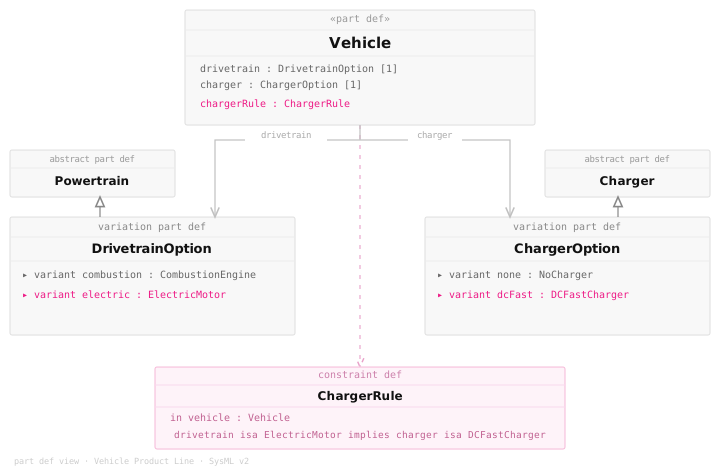
The constraint Constraint (kən-ˈstrānt) n. A constraint is a rule that restricts valid option combinations in a variant configuration model, turning a theoretical variant space into a set of buildable configurations. isn’t a comment in a Word document or a rule buried in a configuration spreadsheet. It lives in the model. A tool that speaks the SysML v2 API can evaluate it automatically — across any configured product variant, at any point in the lifecycle.
Whether that actually happens depends on the rest of the organization.
The Problem Nobody Wants to Name
Variant management isn’t a modeling problem.
That’s the thing no SysML v2 paper says directly. The problems that actually cost companies money are: configuration data that contradicts itself across systems, compatibility rules that exist in spreadsheets or in one engineer’s head but nowhere authoritative, BOMs that diverge between CAD and ERP and nobody knows which one is right.
What SysML v2 changes is the precondition for integration. The API means that, for the first time, a systems model can meaningfully talk to other tools without heroic effort. That’s not the same as actually talking to them. Someone still has to build the integration. Someone still has to own the data governance. The standard creates the possibility; the organization has to do the rest.
Where the Value Is
The companies that will get the most out of SysML v2 for variant management are probably not the ones planning a clean, full-scale MBSE rollout. They’re the ones with a specific, bounded problem: a product line with a manageable number of variation points, a need to formally capture compatibility constraints, and a PLM Product Lifecycle Management (PLM) (ˈprä-dəkt ˈlīf-ˌsī-kəl ˈma-nij-mənt) n. PLM (Product Lifecycle Management) manages product data, processes, and decisions across the full lifecycle — from design through manufacturing, service, and end of life. environment where one or two integrations would unlock real value.
The API-first architecture changes the calculus. Previously, the question was whether SysML SysML (ˈsis-ˌem-el) n. abbr. SysML is a graphical systems modeling language used in variant management to describe product architectures, requirements, and system variability for complex engineered products. was worth the investment given its isolation from downstream tools. Now the question is whether the integration is worth building. That’s a different conversation — and a more tractable one.
It’s also a conversation that requires someone who understands both systems modeling and PLM data architecture. That combination remains rare. The tooling ecosystem is catching up. The human ecosystem less so.
An Honest Assessment
SysML v2 is a genuinely better standard. The textual syntax, the formal semantics, the standardized API — these aren’t incremental improvements. They change what’s possible.
But better infrastructure doesn’t mean better outcomes. The history of PLM is full of standards that enabled things companies never did. STEP enabled interoperability that rarely extended beyond geometry exchange. PDM systems enabled traceability that required people to actually trace things.
SysML v2 carries the same risk. It’s the first version of SysML where the architecture is right for variant management. Whether organizations use it that way depends less on the language and more on whether they’ve decided what problem they’re actually solving.
That’s not a critique of SysML v2. It’s a reminder that the standard is the easy part.
Frequently asked questions
When was SysML v2 officially released?
The Object Management Group (OMG) approved the final adoption of SysML v2.0 on July 21, 2025, alongside KerML 1.0 and the SysML v2 API specification. The specification was published as a formal standard on September 3, 2025. A beta version had been available since July 2023.
What is the difference between SysML v1 and SysML v2?
SysML v1 is a diagram language — nine diagram types built as a UML profile, with models that lived inside their tools and did not exchange well. SysML v2 is built on a formal semantic foundation (KerML) and includes a standardized API as part of the specification. Models are machine-readable, the notation is textual and version-controllable, and variation points are first-class language constructs rather than bolted-on extensions.
What is KerML?
KerML (Kernel Modeling Language) is the semantic foundation underlying SysML v2. It defines the formal type system and metamodel that makes SysML v2 models machine-readable — not just human-readable diagrams. SysML v2 is built on top of KerML, which is itself a standalone OMG standard (KerML 1.0, adopted July 2025).
Does SysML v2 support variant management natively?
Yes — SysML v2 includes explicit language constructs for variation points and variants. In SysML v1, variability had to be modeled with stereotypes or separate tools that never aligned cleanly with the core model. In SysML v2, a variation point is a first-class citizen: definable, formally constrainable, and structurally propagated. What SysML v2 does not do is replace the organizational processes, data governance, and PLM integrations that make variant management work in practice.
Can SysML v2 replace a PLM system for variant management?
No. SysML v2 is a systems modeling language, not a product lifecycle management platform. It can formally capture variant structure, constraints, and configurations — but it does not manage BOMs, engineering changes, manufacturing process data, or ERP integration. The standardized API makes it more connectable to PLM tools than SysML v1 was, but integration still requires deliberate architectural work. SysML v2 and PLM systems address adjacent problems; they are complementary, not interchangeable.